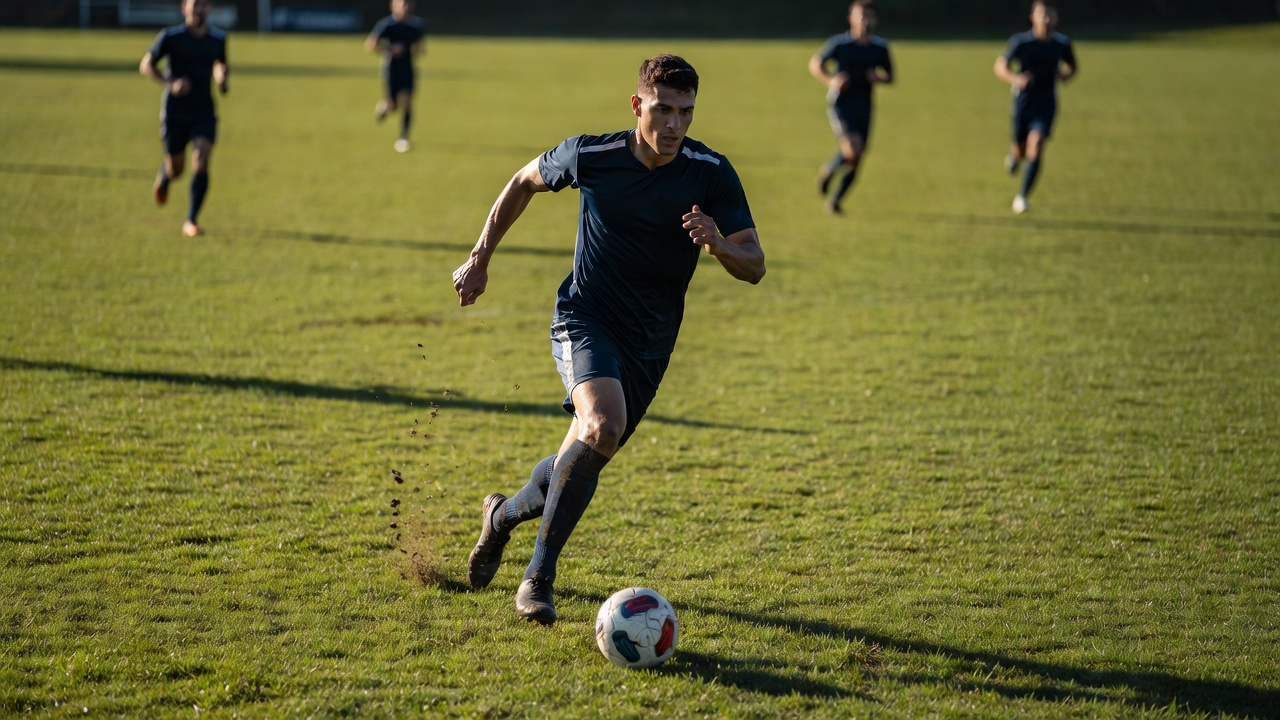
Every tactical plan has two halves: what we do with the ball and what we do without it. Transitions are the seams between those halves. When possession changes, the attacking team is spread out to create space, and the defending team is squeezed together to deny it. For a few seconds, both are in the wrong shape. Many goals are scored in exactly that window.
Coaches usually split transitions into two moments. The defensive transition starts when you lose the ball. The attacking transition starts when you win it. They are mirror images, and good teams prepare for both before they happen.
Losing the ball: two honest choices
When possession is lost, a team broadly chooses between counter-pressing and regrouping. Counter-pressing means the nearest players attack the ball immediately, trying to win it back within a few seconds, while the opponent is still looking up. German coaches popularized the word Gegenpressing for this, and Klopp's teams treated it as their best playmaker: winning the ball high meant a chance against a disorganized defence.
Regrouping means running back behind the ball and rebuilding the defensive block before engaging. It concedes ground and time, but it protects the most dangerous space, the area behind the defence. Neither choice is braver or smarter in general. Counter-pressing requires players to be close together when the ball is lost; regrouping requires the discipline to sprint backwards when every instinct says chase.
Rest defence: preparing for the loss in advance
The best transition defending happens before the ball is lost. Rest defence is the group of players a team keeps behind the ball while it attacks: often two centre-backs and a holding midfielder, sometimes a full-back as well. Their job is to stand where the first counter-attacking pass would go. If the opponent's escape pass is intercepted, the attack can start again immediately. Follow the frames.
Winning the ball: speed with a shape
The attacking transition looks like pure speed, but successful counter-attacks follow patterns too. The first pass after winning the ball should usually go forward or away from pressure, often to a player already facing the opponent's goal. Runners then spread wide to stop defenders from simply retreating into the middle. Claudio Ranieri's Leicester City, Premier League champions in 2015–16, made this look simple: a compact 4-4-2 without the ball, then quick passes into Jamie Vardy running behind and Riyad Mahrez carrying the ball forward.
José Mourinho's Inter, who won the Champions League in 2010, showed another side. In their semi-final against Pep Guardiola's Barcelona they spent long periods defending deep, accepting little possession in exchange for very little space behind them. Whether you find that admirable or frustrating, it was a coherent answer to a specific opponent.
Transitions in other sports
Rugby union coaches talk about "turnover ball", possession won while the opponent's defensive line is still disorganized, and the New Zealand All Blacks have long been studied for attacking it quickly. In ice hockey, a breakout is the coordinated first pass out of the defensive zone after winning the puck. Basketball calls it transition offence: running before the defence is set. Each sport asks the same question: who organizes faster?
What to watch from the stands
- When an attack breaks down, count how many players were behind the ball.
- Watch the nearest three players for two seconds: do they hunt the ball or run back?
- After a turnover, note where the first pass goes and who is already sprinting.
Takeaway: a transition is a race to reorganize. The team that prepared for the turn before it happened usually wins it. Compare all approaches in the strategy matrix.